How to Choose a Dining Table for an Open Concept Home in Canada
The dining table is one of the most loaded decisions in a home. It is where meals happen, where homework gets done, where guests end up after dinner. It anchors the dining zone of your space in a way that almost no other piece of furniture does.
In an open concept home that challenge is even greater. Without walls to define where the dining area begins and ends, your table choice does a lot of the heavy lifting. The wrong size, shape, or placement and the whole floor plan can feel off. The right one and the entire space clicks into place.
Here is exactly how to make that decision without second guessing yourself halfway through assembly.
Why Open Concept Homes Change the Dining Table Equation
In a traditional home with a separate dining room, your table just needs to fit the room and seat your household. The walls do the defining work for you.
In an open concept home, your dining table needs to do something more. It needs to anchor a zone that has no physical boundaries. It sits in a continuous space shared with the kitchen and living room, which means its size, shape, and position all affect how the entire floor plan feels, not just the dining corner.
This is why so many open concept homeowners end up with a dining table that looks fine on its own but feels wrong in the space. It was chosen without accounting for how it interacts with the living room sofa, the kitchen island, and the sight lines running the full length of the room.
Step 1: Measure the Zone, Not Just the Room
The first mistake open concept buyers make is measuring the overall room and picking a table to fit it. In an open concept layout you are not furnishing a room. You are furnishing a zone within a larger continuous space.
Mark out on your floor where the dining area begins and ends. A piece of tape on the floor works well for this. Then measure that specific zone. Your dining table needs to fit within that zone with at least 36 inches of clearance on every side where chairs will be pulled out. That clearance is the minimum needed to move a chair back, stand up, and walk past someone seated comfortably.
For most Canadian open concept homes and condos, a dining table in the 60 to 72 inch range seats four to six people comfortably while leaving enough breathing room around the edges of the dining zone.
Step 2: Choose the Right Shape for Your Layout
Shape is one of the most consequential decisions in dining table selection and it is often made purely on aesthetics when it should be made on layout logic first.
Round tables work best in tighter zones and smaller households. A round table has no corners, which means traffic flows around it more naturally. In an open concept layout where the dining zone is adjacent to a kitchen walkway, a round table reduces the chance of corners interrupting foot traffic. Round tables also encourage conversation because everyone is equidistant from one another. A 48 inch round table seats four adults comfortably and is one of the most versatile choices for Canadian condo and apartment dining zones.
Rectangular tables suit larger households and longer zones. If you regularly seat six or more people or your dining zone is clearly elongated rather than square, a rectangular table gives you the most efficient use of space. The key in an open concept layout is making sure the table length does not compete visually with the sofa or kitchen island on the same sight line.
Oval tables offer the best of both. They have the length of a rectangular table without the sharp corners, which improves traffic flow and softens the visual weight of the piece in a continuous open space. If you are torn between round and rectangular, an oval table in the 66 to 72 inch range is often the answer.
Step 3: Pick a Material That Works With Your Whole Floor Plan
In a room with walls, your dining table material mainly needs to work with that room. In an open concept layout it needs to work with your kitchen, your living room, and any flooring and cabinetry visible from the dining zone simultaneously.
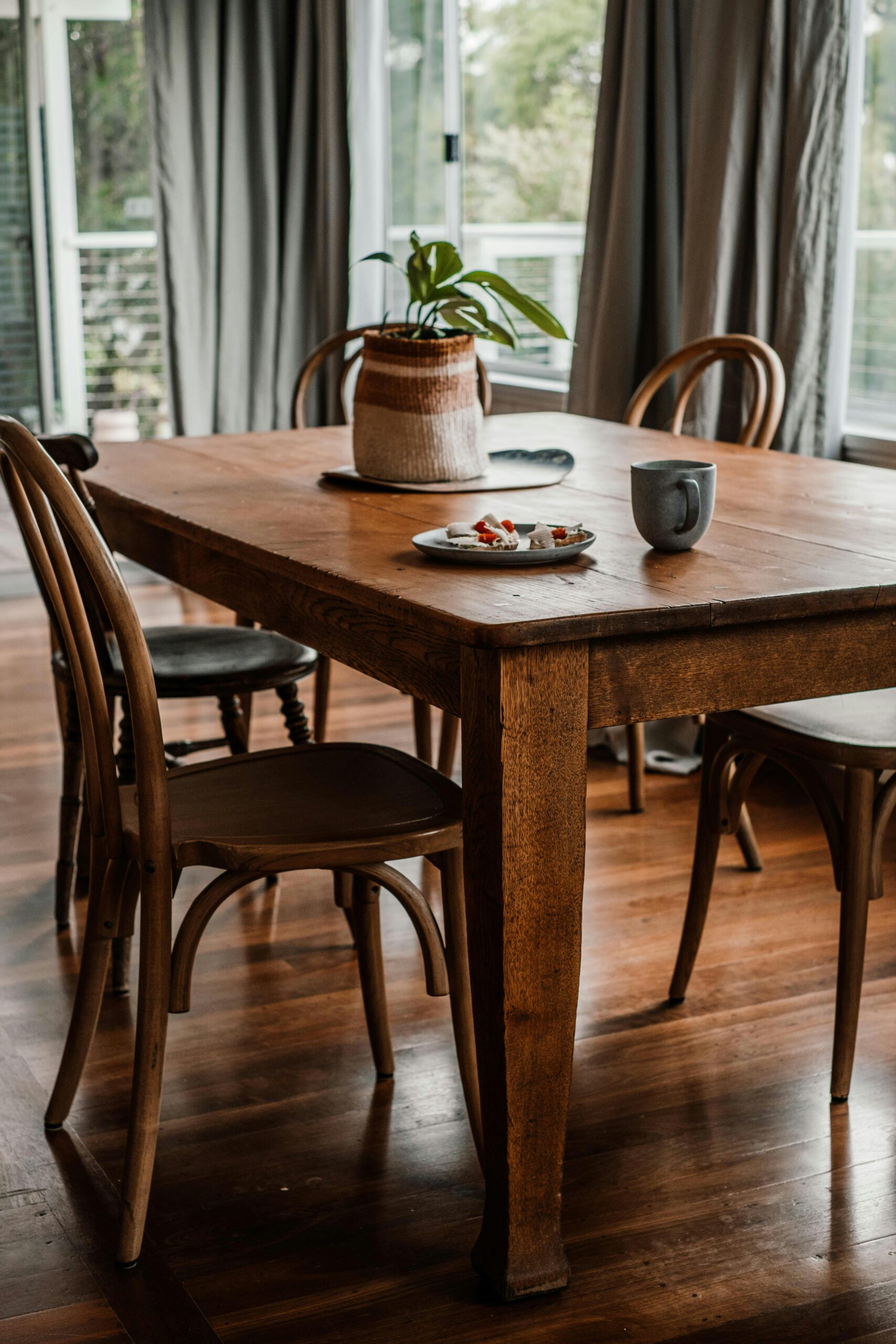
Solid wood is the safest and most versatile choice for Canadian open concept homes. Oak, ash, and walnut all work across a wide range of interior styles from modern to transitional to traditional. Solid wood also ages well, which matters in a piece that will see daily use for years.
If your kitchen has white or grey cabinetry, a warm wood table adds contrast and prevents the space from feeling cold. If your living room leans toward darker or more richly toned furniture, a lighter wood table creates balance across the open floor plan.
Avoid materials that read as too formal or too casual relative to the rest of your space. A glass top table can feel sleek in isolation but look disconnected in an open concept layout where the rest of the furniture is warm and organic. A very rustic reclaimed wood table can feel out of place if the kitchen and living room are contemporary and minimal.
Browse the dining table collection at Furniture Flip for solid wood and quality engineered options suited to Canadian open concept homes across a range of styles and sizes.
Step 4: Position the Table to Define the Zone
Where you place the table matters as much as which table you choose. In an open concept layout, furniture placement is how you create zones without walls.
A pendant light directly above your dining table is one of the most effective zone defining tools available. It draws the eye down to the table and signals that this specific area of the open floor plan has a dedicated purpose. If you do not have a pendant light over your dining area, it is worth considering even if the rest of your lighting is already in place.
A rug under the dining table works the same way on the floor plane. It visually contains the dining zone and separates it from the kitchen and living areas. Make sure the rug is large enough that all four chair legs remain on it even when chairs are pulled out fully. A rug that chairs slide off of when someone stands up is too small.
Your dining table should also relate sensibly to your kitchen island or peninsula if you have one. As a general rule, leave at least 42 to 48 inches between the island and the nearest edge of the dining table. Any closer and the two pieces start to compete and the space between them becomes awkward to navigate.
Step 5: Think About Extendability If You Host Regularly
If you regularly have guests for dinner but your everyday household is two to four people, an extendable dining table is one of the smartest investments you can make in an open concept home.
An extendable table that seats four day to day and extends to seat eight for holidays or dinner parties means you get the right sized table for your actual daily life without sacrificing hosting capacity. In a Canadian open concept home where the dining zone is visible from the living room and kitchen at all times, a table that is right sized for the household makes the entire floor plan feel more proportionate on an everyday basis.
The extension leaf mechanism has also improved significantly in recent years. Modern extension tables are far less fussy to operate than older designs and most can be extended by one person in under a minute.
A Note on Dining Chairs in Open Concept Spaces
Your chair choice affects how heavy or light the dining zone feels in the broader open floor plan. In an open concept layout where visual weight matters across the entire space, chairs with slimmer profiles and exposed legs tend to work better than fully upholstered or chunky designs.
Mixing chair styles, such as upholstered end chairs with wooden side chairs, is a popular approach in Canadian open concept homes and works well as long as the materials relate to one another and to the table itself.
For a complete dining setup that works with your open floor plan, take a look at the tables collection at Furniture Flip where you will find dining tables alongside console tables and side pieces that help anchor and define open concept zones.
For additional guidance on dining table sizing and material selection specific to Canadian homes, Global News has a thorough dining table buying guide put together with input from Canadian furniture retailers and interior designers that is worth reading before you finalize your decision.
The Bottom Line
Choosing a dining table for an open concept home in Canada is not just a furniture decision. It is a spatial planning decision. Get the size and shape right for your zone, choose a material that works across your whole floor plan, position the table with intention, and let lighting and a rug do the defining work that walls cannot.
Done right, your dining table will not just be a place to eat. It will be the piece that makes the whole open concept layout feel complete.
Take a look at these picks!